
The Role of Sodium Bicarbonate in Modern Food & Beverage Processing
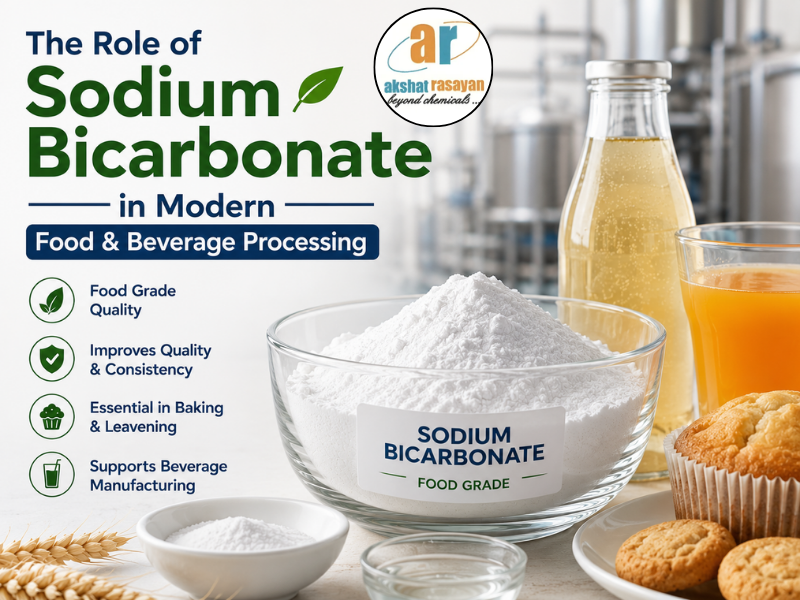
Sodium bicarbonate, commonly known as baking soda, has been a kitchen staple for generations. But its role today goes far beyond home baking. Across large-scale food production, packaged snacks, dairy items, and beverages, sodium bicarbonate for food and beverage industry applications has become an essential part of manufacturing processes. It helps control texture, taste, shelf life, and even the visual appeal of the final product.
In this blog, we will look at why sodium bicarbonate is so widely used in food processing today, where it fits into different product categories, and what makes it a trusted ingredient for manufacturers.
Lorem ipsum dolor sit amet, consectetur adipiscing elit. Ut elit tellus, luctus nec ullamcorper mattis, pulvinar dapibus leo.
What Is Sodium Bicarbonate?
Sodium bicarbonate (NaHCO₃) is a white crystalline powder with mild alkaline properties. It is widely used in the food industry because it reacts with acids to release carbon dioxide gas. This reaction is especially useful in baking, where it helps dough and batter rise.
Food-grade sodium bicarbonate is manufactured under strict quality standards to ensure it is safe for use in food products.
Why Sodium Bicarbonate Is Important in Food Processing
Modern food manufacturing requires ingredients that improve product quality while maintaining consistency. Sodium bicarbonate meets these requirements by performing several important functions during food production.
It helps manufacturers:
- Improve product texture
- Maintain the desired pH level
- Enhance product consistency
- Support efficient food processing
- Improve the quality of finished products
Its versatility makes it suitable for many different food and beverage applications.
What Makes Sodium Bicarbonate So Useful in Food Processing
Sodium bicarbonate is a simple compound, but it offers a combination of properties that food scientists find hard to replace. It is a mild alkali, which means it can neutralize acids. It also releases carbon dioxide gas when it reacts with heat or acidic ingredients, which is why it works so well as a leavening agent.
Beyond leavening, it is valued for its ability to:
- Balance pH levels in food formulations
- Improve texture and softness in baked goods
- Act as a buffering agent in processed foods
- Support color and flavor stability
- Help control acidity in beverages
This range of functions is why sodium bicarbonate for food and beverage industry use has grown steadily, not just in bakeries but across dairy, meat processing, and drink manufacturing as well.
Sodium Bicarbonate as a Leavening Agent
The most familiar use of sodium bicarbonate is in baked goods. When combined with an acidic ingredient like buttermilk, yogurt, or cream of tartar, it produces carbon dioxide bubbles. These bubbles get trapped in the batter or dough, giving bread, cakes, cookies, and crackers their light and airy texture.
For commercial bakeries, consistency matters a great deal. Sodium bicarbonate offers predictable results batch after batch, which is why it remains a preferred leavening agent even with the availability of other raising agents in the market.
Use in Dairy Products
Sodium bicarbonate also plays an important role in dairy processing. Milk naturally develops acidity over time, especially during storage and transport. Adding a small, controlled amount of sodium bicarbonate helps neutralize this excess acidity, which in turn helps prevent curdling during heat treatment processes like pasteurization.
It is also used in certain cheese and ice cream formulations to maintain a stable pH, which affects texture, taste, and shelf stability.
Application in Meat and Poultry Processing
In meat processing, sodium bicarbonate is sometimes used to improve water retention and tenderness. It can help modify the surface pH of meat products, which supports better texture and juiciness after cooking. This makes it useful in processed meat items where consistent quality is expected across large production batches.
Role in Beverage Manufacturing
The beverage industry is another major user of sodium bicarbonate. It is commonly added to:
- Carbonated soft drinks, where it helps balance acidity from other ingredients
- Sports and functional drinks, where it supports electrolyte-style formulations
- Flavored water and health drinks, where controlled alkalinity is required
Because sodium bicarbonate is generally recognized as safe when used within permitted limits, it fits well into both mass-market and health-focused beverage lines.
Why Manufacturers Prefer Food Grade Sodium Bicarbonate
Not all sodium bicarbonate is suitable for food use. Manufacturers specifically look for food-grade sodium bicarbonate, which meets purity and safety standards required for consumption. This grade is tested for particle size, solubility, and contamination levels, ensuring it performs reliably in sensitive formulations like infant food, bakery mixes, and beverages.
Using a verified food grade sodium bicarbonate supplier also helps companies stay compliant with food safety regulations, which is increasingly important as scrutiny around ingredient sourcing grows across the food and beverage sector.
Shelf Life and Product Stability
Another reason sodium bicarbonate is widely used is its impact on shelf life. By helping control pH and acidity, it can slow down certain spoilage reactions in processed foods. This is particularly useful in packaged snacks, sauces, and ready-to-eat products, where maintaining freshness over a longer period is a key business requirement.
Sustainability and Cost Efficiency
From a manufacturing standpoint, sodium bicarbonate is also attractive because it is relatively inexpensive compared to many specialty additives, while still delivering multiple functional benefits. This makes it a cost-effective choice for large-scale food producers who need reliable performance without significantly increasing production costs.
Conclusion
From baked goods and dairy to meat processing and beverages, sodium bicarbonate continues to be a versatile and dependable ingredient across the food industry. Its ability to manage acidity, support texture, and extend shelf life explains why demand for sodium bicarbonate for food and beverage industry applications keeps growing alongside the expansion of packaged and processed food markets.
For businesses looking for a reliable and consistent supply, Akshat Rasayan is a leading provider of sodium bicarbonate, offering food-grade quality suited for diverse food and beverage manufacturing needs.